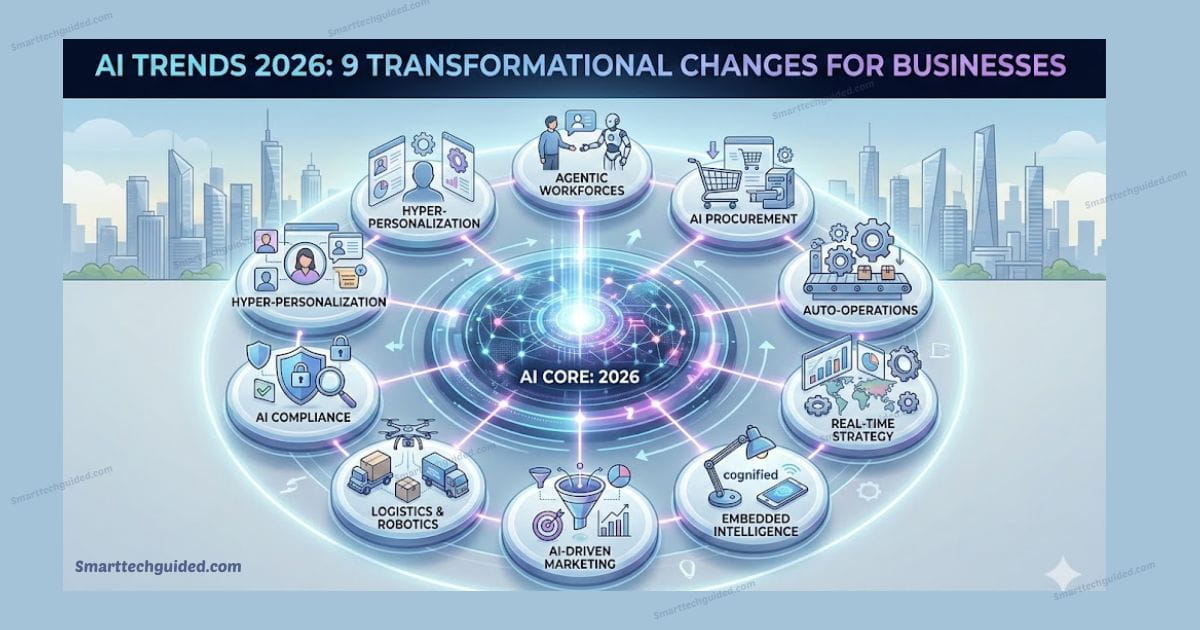
Artificial intelligence is evolving quickly, but AI trends in 2026 are not only about smarter algorithms or larger models. The real shift is happening in how organizations apply artificial intelligence to solve practical business problems. According to research and industry insights from organizations such as IBM, Microsoft, Google, Stanford University, and McKinsey, companies are entering a stage where AI is becoming deeply embedded in operations, decision-making, and innovation strategies.
Many organizations already experiment with AI tools, yet most remain in early adoption stages. A McKinsey report notes that while a large share of companies use AI in at least one business function, only a small group has successfully integrated it across their operations.
This gap highlights why businesses must prepare for the next phase of artificial intelligence trends 2026, a phase focused on workflow automation, human collaboration with AI systems, specialized models, and strong governance.
Understanding these developments is critical for leaders, professionals, and organizations aiming to remain competitive. The following guide explains nine transformational changes in business and technology expected in the coming years. It outlines what businesses must prepare for to stay ahead in an increasingly AI-driven economy. Lets break down the topic.
AI Trends Driving Autonomous Business Workflows

AI Trends is shifting from simple chat assistants to systems capable of managing entire processes. One of the most important AI technology trends for 2026 is the rise of autonomous AI agents that coordinate tasks across software platforms, data systems, and communication tools. Instead of responding to single prompts, these agents execute complex workflows independently.
How AI Agents Are Transforming Business Workflows?
AI agents are built to handle tasks by connecting with different systems and tools at the same time. Instead of simply responding to individual questions, these systems can collect information, process it, and carry out actions on their own.
For instance, an employee might ask for sales performance insights, and the AI agent can automatically pull data from databases, create a report, and share the results with the appropriate team members.
According to research from the IBM Institute for Business Value, the next stage of competition among companies will depend less on who has the most powerful AI model and more on who can effectively coordinate multiple AI tools into automated workflows.
In practice, some organizations have already introduced AI agents that translate everyday language questions into database queries. This has helped reduce the time employees spend analyzing data, in some cases dramatically improving efficiency for large teams.
These developments show how major business transformations are taking place through automation. When organizations integrate AI agents into their digital systems, they can streamline operations, minimize repetitive work, and make faster, more informed decisions.
Why Businesses Must Prepare for Autonomous AI Systems?

Another major development in AI trends 2026 is the increasing collaboration between humans and intelligent systems. Instead of replacing workers, AI is becoming a productivity partner that enhances human capabilities.
Why AI Trends 2026 Show AI Augmenting Human Capabilities?
Many experts believe AI delivers the best results when it supports human abilities instead of replacing them. Machines are very good at processing large amounts of data, identifying patterns, and creating initial drafts. Humans, however, bring important skills such as critical thinking, creativity, and contextual understanding.
Research from Microsoft’s Work Trend Index shows that AI tools help professionals reduce the time spent on repetitive tasks like analyzing data, preparing documents, or searching for information. As a result, employees can dedicate more time to strategic thinking, innovation, and building stronger relationships with customers.
Here is how this collaboration typically works:
- AI handles data-heavy tasks – analyzing information, spotting trends, and generating reports quickly.
- Humans add context and judgment – interpreting insights and making informed decisions.
- AI supports faster research – helping teams explore markets and competitors more efficiently.
- People focus on strategy – refining AI outputs and shaping the final direction of projects.
For example, in marketing, a small team can use AI tools to research market trends, evaluate competitors, and create initial campaign content. The team then improves and adapts that content to align with brand strategy and audience needs. This kind of collaboration highlights a broader organizational transformation, where productivity increases while human expertise remains essential.
AI Trends Shaping New Hybrid Roles in the Workplace?
As AI adoption continues to grow, many industries are beginning to see the emergence of new types of job roles. Companies are increasingly looking for professionals who not only understand business operations but also have a solid understanding of AI technologies and how they can be applied effectively.
Some examples of these roles include AI governance specialists, data strategists, and prompt designers who help shape how AI systems interact with users. Research from Stanford’s Human-Centered AI (HAI) program highlights that these hybrid roles are becoming important for making sure AI tools are used responsibly and efficiently within organizations.
In the coming years, professionals who combine strong domain expertise with AI knowledge will likely lead projects and guide teams through technological change. This shift shows why organizations must focus on strategic readiness for human-AI collaboration. Businesses that invest in training, education, and skill development will be better prepared to adapt to the changing workplace.
Key points:
- New job roles are emerging as AI adoption expands across industries.
- Companies need professionals with both business and AI knowledge.
- Roles like AI governance specialists and prompt designers are growing in demand.
- Stanford research highlights the importance of responsible AI implementation.
- Organizations investing in training and skills development will adapt faster to future workplace changes.
AI Trends 2026: Why Are Specialized AI Models Rising?

While large AI models have dominated headlines, a key AI Trends forecast for 2026 is the growing importance of specialized models designed for specific industries or tasks. These systems offer efficiency, speed, and accuracy advantages compared to general-purpose models.
Why Are Smaller Domain-Specific AI Models Replacing Large Ones?
General AI models are powerful, but they often require a large amount of computing power to operate. Because of this, they are not always the most practical option for every business use case. In many situations, smaller AI models trained on specific datasets can deliver more accurate and reliable results for particular tasks.
Research from IBM on enterprise AI architecture shows that specialized models can run on local servers or devices while still providing faster responses and better accuracy.
For example, a healthcare organization might use an AI model trained specifically on medical imaging data instead of relying on a general-purpose language model. This focused approach helps the system perform better in that specific field.
Using specialized models also reduces computing costs and improves reliability, especially in environments where precision is essential. As companies look for practical solutions rather than experimental technologies, these targeted systems are expected to play a major role in AI trends 2026.
How Efficient AI Models Reduce Cost and Improve Accuracy?
Another key benefit of specialized AI models is better operational efficiency. Large AI models that run in the cloud often require significant computing power, which can lead to higher expenses related to processing and data transfer.
When organizations use smaller models designed for specific tasks, they can manage their systems more efficiently while also reducing costs and improving performance. This approach also helps companies maintain stronger control over their data and infrastructure. So, you can say that AI can do everything!
Here are the main advantages of using specialized AI models:
- Lower operational costs – Large cloud-based models can be expensive because of high computing and data transfer requirements.
- Better control over data privacy – Smaller models can run on local systems, giving organizations more control over sensitive data.
- Improved accuracy in specific tasks – Since these models focus on narrow domains, they are less likely to produce incorrect or irrelevant outputs.
- More efficient infrastructure management – Businesses can optimize their AI architecture without relying entirely on large cloud systems.
- Support for digital transformation – Many organizations are now adopting hybrid strategies that combine powerful large models with smaller specialized systems for better results.
AI Trends 2026: Edge Computing Transforming Businesses

AI applications require powerful computing infrastructure. One of the most important AI trends for advancements in 2026 involves new computing models that distribute processing across cloud platforms, local devices, and edge environments.
The Rise of Distributed AI Infrastructure
Technology companies are building extensive networks of data centers and processing systems to handle AI workloads across the world. Microsoft describes these systems as large-scale AI processing networks that can direct tasks to available computing resources wherever they are located.
This type of infrastructure allows organizations to scale their AI applications more efficiently. Instead of depending on a single server or location, tasks can be distributed across a global network of systems. As a result, performance improves, and delays are reduced when processing complex data. AI is not only used in Business but in everyday tasks! Many people are starting to use AI influencers for product promotion.
For businesses going through organizational transformation, having access to flexible AI infrastructure will be increasingly important. It allows teams to implement AI solutions across different departments while maintaining strong performance, reliability, and operational stability.
How Robotics and Edge AI Are Transforming Industries?
Multimodal AI is becoming a key AI trend in 2026 because modern systems can process and combine different data types such as text, images, audio, and video. This capability allows AI to better understand complex information and deliver more accurate, human-like responses across various applications. Lets discuss below!
How Multimodal Systems Combine Text, Images, Audio, and Data?
Multimodal AI models analyze several data formats simultaneously. For example, a system could interpret written instructions, analyze visual data, and generate a response that integrates both.
Projects such as Google’s Gemini AI aim to develop models capable of understanding text, video, images, and other data sources within a single system. This capability allows AI to interpret complex scenarios more accurately.
In fields like healthcare and engineering, combining different data types can reveal insights that would otherwise remain hidden. As organizations adopt these systems, multimodal capabilities will play an important role in future AI advancements in 2026.
The Role of World Models in Advanced AI Reasoning
- Another key concept linked to multimodal AI is the development of “world models.” These systems are designed to understand cause-and-effect relationships and predict how environments may change over time.
- World models are particularly valuable for robotics and autonomous systems that need to interact with real-world environments.
- By learning patterns of movement and behavior, AI can simulate possible outcomes before making a decision or taking action.
- This ability helps systems respond more effectively to complex or changing situations.
- Ongoing research shows that future AI systems may move beyond simple pattern recognition and develop stronger reasoning abilities.
- As a result, AI could support a much wider range of real-world applications in the coming years.
Healthcare Innovation Is One of the Biggest AI Trends 2026

Healthcare is emerging as one of the sectors most affected by artificial intelligence trends in 2026. AI tools are improving diagnostics, research, and healthcare management.
How AI Is Improving Diagnosis and Clinical Decision-Making?
AI systems can process medical data such as imaging scans, patient records, and lab results much faster than traditional methods. In many situations, these tools support doctors by identifying possible diagnoses or recommending treatment options based on the data.
Studies related to Microsoft’s AI diagnostic systems show that advanced AI models can reach high levels of accuracy when analyzing complex medical cases. Even so, these technologies are designed to assist healthcare professionals, not replace them.
Medical experts still make the final decisions and remain responsible for patient care. AI simply provides additional insights that help doctors review information more quickly and efficiently. As patient demand continues to grow, these tools can help healthcare systems improve both the speed and accuracy of medical services.
The Impact of AI on Drug Discovery and Medical Research
Enterprise AI Adoption Is Driving Business Transformation
Many companies have already begun integrating AI into their operations. However, widespread business transformation requires more than simply adopting new technology.
Why Businesses Must Redesign Workflows Around AI Systems?
Organizations often fail to capture the full value of AI because they treat it as an additional tool rather than redesigning processes around it. According to McKinsey research on AI adoption, companies that integrate AI into core operations achieve significantly greater performance improvements.
Redesigning workflows means identifying tasks that can be automated, supported, or enhanced by AI. Teams can then focus on strategic work while machines handle repetitive activities.
This approach requires careful planning, data governance, and collaboration between technology and business teams. Companies that invest in these foundations will be better prepared for future AI technology trends in 2026.
How AI Platforms Create Strategic Competitive Advantage?
Another factor shaping enterprise transformation is the development of internal AI platforms. These systems allow employees from different departments to access AI tools safely and efficiently.
Instead of relying on isolated projects, organizations can build centralized infrastructure that supports experimentation and innovation. Data teams, finance departments, and marketing teams can all use the same platform to explore insights and automate tasks.
Such strategies strengthen strategic readiness and allow companies to scale AI initiatives more effectively. Over time, this capability can become a major competitive advantage.
Security and Privacy Will Become Critical in the AI Trends 2026

As AI systems become more powerful and autonomous, security and privacy concerns will grow. Protecting sensitive data and ensuring responsible AI use will be essential for organizations adopting advanced technologies.
Why AI Systems Require Strong Security and Trust Frameworks?
- AI agents often work with sensitive information such as financial records, customer data, and internal communications. If proper security measures are not in place, these systems can create potential risks and vulnerabilities for organizations.
- Experts highlight the need for strong security practices. This includes identity management, encrypted communication, and strict access controls. Companies should manage AI agents much like employees by assigning permissions and monitoring their activities.
- Strong security also helps build customer trust. Organizations that focus on transparency and accountability are more likely to succeed as AI continues to evolve toward 2026.
How AI Is Helping Detect and Prevent Cyber Threats
Interestingly, AI itself is becoming a powerful tool for cybersecurity. Intelligent systems can analyze network activity, identify suspicious patterns, and respond to threats faster than manual monitoring methods.
Security teams increasingly rely on AI to triage alerts, investigate incidents, and detect unusual behavior in large datasets. These capabilities enable faster responses to potential cyber attacks.
As digital environments grow more complex, combining AI with human expertise will become essential for protecting critical systems and data.
Governance and Regulation Will Shape the Future of Artificial Intelligence
The rapid expansion of AI technology has prompted governments and institutions to develop new regulatory frameworks. Policy decisions will play a major role in shaping how AI systems are deployed globally.
Why Is AI Governance Important for Businesses?
Regulators are increasingly concerned about the potential risks associated with AI systems, including bias, misinformation, and privacy violations. In response, governments are developing laws and guidelines for responsible AI use.
The European Union’s AI Act represents one of the most comprehensive regulatory frameworks currently under development. It categorizes AI applications based on risk levels and imposes strict requirements on high-risk systems such as healthcare or public infrastructure.
Such policies demonstrate how governance will influence future AI technology trends in 2026.
How Responsible AI Development Builds Public Trust?
Responsible AI practices involve transparency, accountability, and ethical considerations. Companies must ensure that their systems are fair, explainable, and aligned with societal values.
Organizations are increasingly creating internal governance teams to evaluate AI systems before deployment. These teams review datasets, algorithms, and potential risks.
By prioritizing ethical design and responsible implementation, companies can build public trust and reduce regulatory risks. In the long term, responsible innovation will be essential for sustainable AI growth.
Sum Up
The AI trends for 2026 show how quickly artificial intelligence is becoming part of everyday business operations. Technologies such as autonomous agents, multimodal systems, and stronger governance frameworks are shaping the next phase of digital transformation across industries.
Key points to remember:
- Autonomous AI agents are starting to handle complex tasks and streamline business workflows.
- Human–AI collaboration is changing how teams work and improving productivity.
- Specialized AI models are providing faster and more accurate results for specific use cases.
- Advanced AI infrastructure and edge computing are helping organizations scale AI applications efficiently.
- Multimodal AI systems can combine text, images, audio, and data to generate deeper insights.
- AI in healthcare and research is supporting faster diagnosis and accelerating drug discovery.
- Enterprise AI integration is helping businesses improve operations and innovation.
- AI security and governance are becoming essential to protect data and ensure responsible use.
- Global AI regulations and policies are guiding the ethical development of AI technologies.
For businesses, the most important step is being prepared. Organizations need to invest in data infrastructure, improve AI knowledge within their teams, and create governance systems that support responsible AI adoption.
In the long run, companies that treat AI as a strategic capability rather than just a tool will be better positioned to grow and adapt in the evolving AI landscape.
Stay tuned for new updates, hope this finds you well!

Leave a Reply