
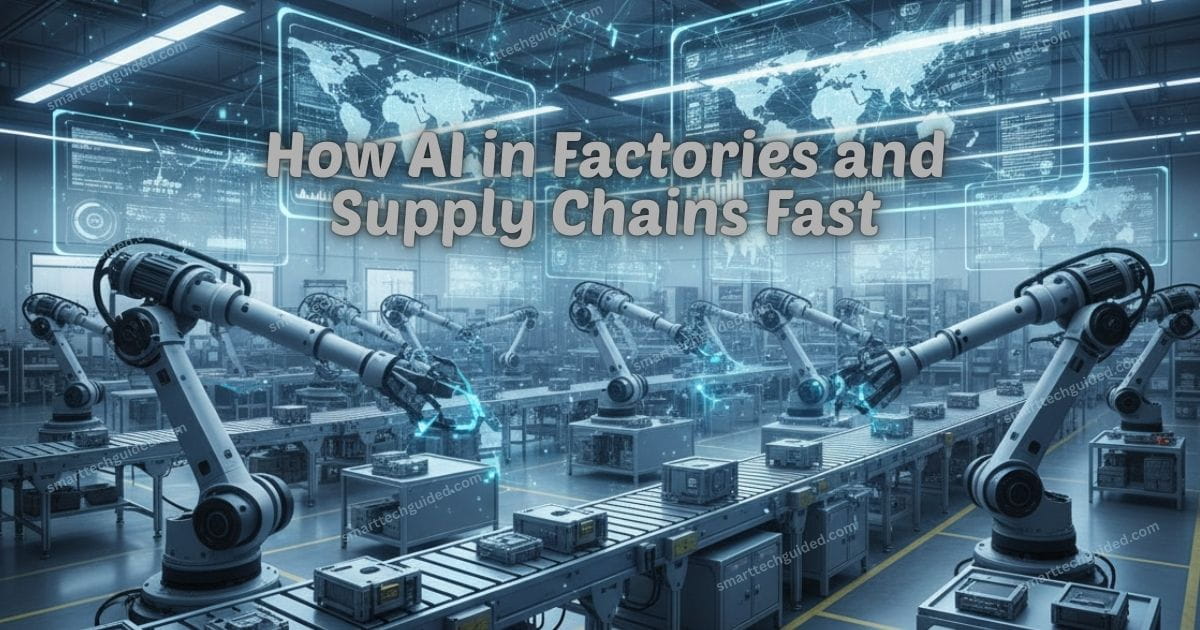
Artificial intelligence is no longer an experimental technology it is now central to AI in factories and supply chains, transforming how industrial operations are planned, executed, and optimized. Companies that adopt AI can make faster, smarter decisions, reduce operational costs, and uncover new opportunities for growth and efficiency. From predictive maintenance to inventory management, AI helps firms to anticipate challenges before they arise and respond proactively.
The real impact of AI goes beyond automation; it empowers people by providing actionable insights, streamlining complex workflows, and enhancing collaboration across teams and departments. Instead of fearing disruption, modern factories and supply chains leverage AI to optimize resources, improve quality, and enhance customer satisfaction. By embedding AI into core operations, organizations gain a competitive edge, accelerate innovation, and ensure resilience in an increasingly complex global market. AI in factories and supply chains is no longer optional it’s a strategic necessity.
AI in Factories The Rise of Smart Industrial Facilities
AI is revolutionizing traditional factories, turning them into intelligent, data driven production centres. Forward-thinking manufacturers leverage AI to boost efficiency, reduce costs, and enhance sustainability. Key applications include:
- AI-driven robotics that automate repetitive tasks, freeing human workers for higher value activities.
- Sensors and IoT devices that monitor equipment in real-time, detecting anomalies before they escalate.
- Predictive maintenance that anticipates failures, reducing downtime and extending machinery life.
- Virtual twin technology that models operations, optimizing energy use, workflow, and resource allocation.
Rather than seeing AI as a cost or complexity, innovative factories treat it as a multiplier of productivity and sustainability. For example, companies using AI-powered predictive analytics report up to 30% reduction in machine downtime and significantly faster production cycles, demonstrating tangible business and operational impact.
AI Enabled Industrial Operations Smarter Decisions at Every Step
Industrial organizations face growing pressures, from ageing infrastructure and talent shortages to increasing demands for sustainability, electrification, and carbon reduction. AI in factories and supply chains helps bridge the gap between strategic goals and day to day operations, enabling smarter, faster, and more precise decision making.
Key applications include:
- Real-time performance monitoring to track equipment, production, and energy usage.
- Automated decision recommendations that guide operators in optimizing processes.
- Scenario simulation to test operational changes, forecast outcomes, and minimize risk.
By leveraging AI, operators can anticipate issues before they escalate, respond proactively, and reduce waste. This not only increases productivity but also supports sustainability goals, enhances safety, and ensures consistent, high-quality output across industrial operations.
AI in Supply Chains Fast, Flexible, and Resilient
Modern supply chains face constant disruption from shifting demand and inflation to geopolitical uncertainty. AI in factories and supply chains enhances visibility, speed, and resilience, helping organizations respond proactively to challenges.
Key benefits include:
- Data integration from internal systems, suppliers, and external market sources for a complete operational view.
- Pattern recognition across fragmented processes to identify inefficiencies and risks.
- Scenario simulation to test supply, production, and logistics strategies before implementation.
- Optimization of inventory, procurement, and distribution to reduce waste and improve service levels.
Companies leveraging AI in supply chains report faster response times, lower operational costs, and higher customer satisfaction. By combining predictive insights with real-time monitoring, AI transforms complex supply networks into agile, resilient, and data-driven systems.
Opportunities for SMEs and Startups
AI isn’t limited to large corporations small and medium-sized enterprises (SMEs) and startups can also reap significant benefits. AI in factories and supply chains allows smaller organizations to operate efficiently, make smarter decisions, and scale quickly without heavy investment in infrastructure.
Key advantages include:
- Automating repetitive processes with minimal staff, freeing teams for higher-value tasks.
- Accessing advanced analytics and insights without needing costly in-house technology or expertise.
- Scaling operations quickly using AI tools to optimize production, inventory, and logistics.
This democratisation of AI levels the playing field, enabling SMEs and startups to compete with larger enterprises, improve efficiency, and respond faster to market demands. With the right strategy, AI empowers smaller organizations to innovate, reduce costs, and grow sustainably in complex industrial ecosystems.
AI and Workforce Empowerment
AI doesn’t replace human workers it empowers them. AI in factories and supply chains enhances human capabilities, enabling employees to focus on higher-value tasks while AI handles routine or data-intensive processes.
Key benefits include:
- Focusing on creative problem-solving instead of repetitive tasks.
- Making faster, more informed decisions using AI-driven insights.
- Enhancing collaboration through AI-assisted workflow and real-time data sharing.
- Building new skills in analytics, automation, and AI management.
By upskilling employees and integrating AI thoughtfully, organizations ensure humans and machines work together seamlessly. This collaborative approach improves productivity, drives innovation, and prepares the workforce for the future of industrial and supply chain operations, creating a more resilient and capable team.
Sustainability and Efficiency Gains
AI is transforming industrial and supply chain operations, not only by boosting efficiency but also by promoting sustainability. AI in factories and supply chains helps organizations minimize environmental impact while improving productivity.
Key benefits include:
- Optimized energy usage in smart factories, reducing waste and lowering costs.
- Smarter logistics that cut fuel consumption and carbon emissions across supply networks.
- Efficient resource allocation, ensuring materials and equipment are used effectively.
- Predictive modelling to anticipate environmental impacts and guide sustainable decision-making.
Forward-thinking companies view AI as both an operational and environmental advantage. By integrating AI into daily operations, organizations can achieve higher efficiency, reduce their carbon footprint, and create sustainable practices that align with business goals and global environmental standards.
Turning Intelligence into Action
The real challenge isn’t simply acquiring AI it’s embedding it into core workflows. AI in factories and supply chains turns data and insights into actionable decisions, transforming operations from reactive to proactive.
Key impacts include:
- Continuous decision-making powered by real-time AI insights rather than delayed responses.
- Streamlined end-to-end processes that connect production, logistics, and supply chain management.
- Improved operational efficiency across equipment, teams, and resources.
When AI is fully integrated, it becomes a strategic partner rather than just a tool. Leaders can make faster, more confident decisions, adapt to changing conditions, and unlock both productivity and innovation in industrial and supply chain operations. By turning intelligence into action, organizations gain resilience, agility, and a sustainable competitive advantage.
Best Practices for Implementing AI
Successfully leveraging AI in factories and supply chains requires strategy, preparation, and continuous refinement. Here are proven best practices:
- Define clear objectives: Focus on measurable outcomes like reduced downtime, faster production, or improved supply chain resilience.
- Clean and connect data: AI insights are only as accurate as the data behind them. Ensure your data is complete, standardised, and integrated across systems.
- Start small, scale fast: Pilot projects allow testing AI applications on a smaller scale before full integration, reducing risk and building confidence.
- Invest in workforce training: Equip employees with AI skills and knowledge to make smarter, collaborative decisions. Humans and AI together drive the greatest impact.
- Measure, refine, repeat: Continuously monitor performance, learn from results, and adjust AI models and workflows to maintain relevance and effectiveness.
Following these best practices ensures AI delivers measurable results while supporting sustainable growth and operational excellence.
- How does AI improve supply chain efficiency?
AI analyzes data from multiple sources, predicts demand fluctuations, simulates different scenarios, and optimizes inventory, procurement, and logistics, allowing organizations to respond faster and reduce costs.
- What is an AI-enabled factory?
An AI-enabled factory uses advanced sensors, IoT, and machine learning systems to monitor operations in real-time, automate tasks, and optimize production workflows for efficiency and quality.
- Can small businesses benefit from AI?
Absolutely. AI tools are scalable and cost-effective, helping SMEs automate repetitive processes, make better decisions, optimize operations, and compete effectively with larger enterprises.
Wrap Up
From factories to supply chains, AI drives smarter, faster, and more informed decisions that transform the way organizations operate. Companies that adopt AI strategically gain resilience, operational efficiency, and sustainable growth, turning complex challenges into opportunities.
Rather than replacing humans, AI empowers employees to focus on creative problem solving, proactive decision making, and innovation. By combining human expertise with AI insights, organizations can optimize processes, reduce waste, improve supply chain visibility, and accelerate production cycles. The future of industrial operations is not AI versus humans it is humans and AI working together to drive efficiency, agility, and long-term success.



Leave a Reply