

Struggling to write faster without sacrificing quality? AI writing tips can help. When I first used tools like ChatGPT, DeepL, Grammarly, and Free AI writer, I let them do it all, producing correct but bland content. I soon learned that the best results come when I stay in control, using AI as a support tool, not a replacement. These OpenAI tools no doubt improve efficiency.
This guide gives practical AI writing tips to boost clarity, structure, and speed while sounding natural. Learn how to write better content without sounding robotic. AI tools can help you do it right.
Table of Contents
ToggleNow that you understand the basics, let’s explore what it truly means to write well with AI.

Writing well with AI means using artificial intelligence as a partner in the writing process rather than a replacement for your own creativity. It’s about combining human insight, clarity, and purpose with AI’s ability to suggest ideas, improve structure, and enhance readability. For example, you might use AI to generate topic ideas or draft an outline, then shape the content in your own voice to ensure it’s engaging and accurate.
Key points:
- AI helps with research, structure, and grammar, while the human writer defines tone and meaning.
- Writing well with AI involves planning first and using AI to enhance your ideas, not replace them.
- Effective use includes iterating drafts, refining suggestions, and ensuring all content reflects your perspective.
So, writing well with AI isn’t about shortcuts; it’s about enhancing your creativity and efficiency while keeping your unique voice and expertise at the center.
Having established why writing well with AI matters, let’s address a key question that often arises: Can AI really replace human writing skills?
Many people wonder if AI can fully replace human writing skills, but the answer is no. While AI can generate text quickly, suggest ideas, and correct grammar, it cannot replicate human creativity, emotional insight, or nuanced understanding (Harvard Business)
For example, AI might produce a grammatically correct paragraph, but it won’t capture personal anecdotes, cultural context, or humor in the way a human writer can. So, AI is a powerful writing tool, not a replacement. Using AI responsibly means enhancing your skills and speed while preserving your unique perspective and authority.
How to Use AI for Writing: Step-by-Step Guide
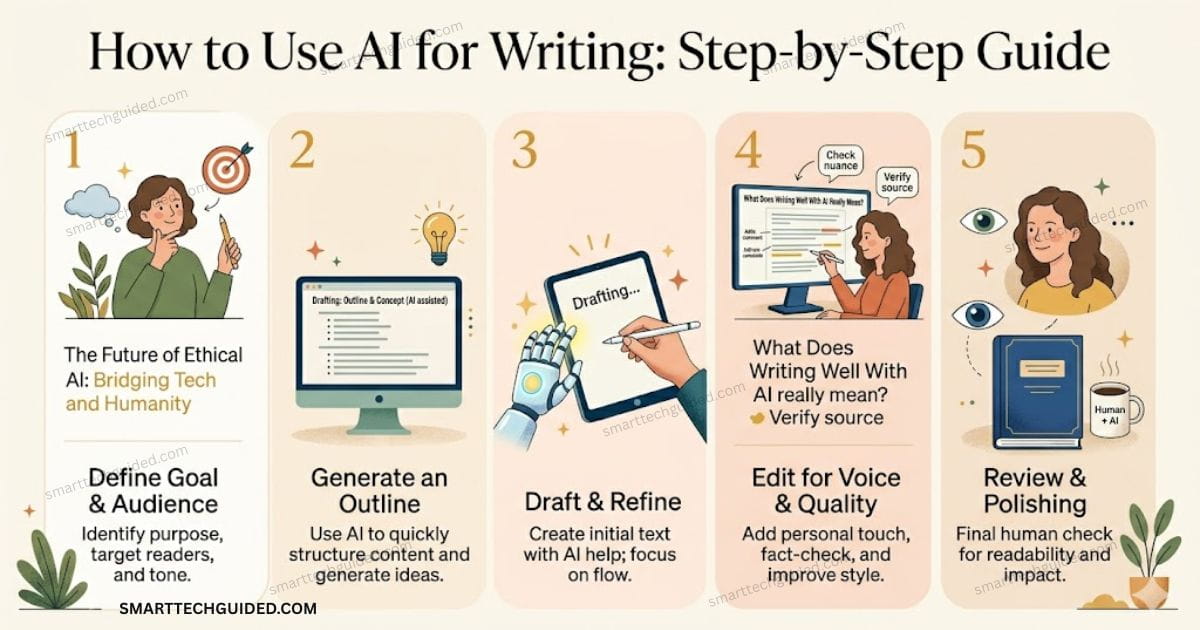
Using AI for writing is most effective with a structured approach. Treat AI as a tool to boost your process while relying on your creativity. Your ideas, combined with AI suggestions, lead to faster, clearer, and more engaging writing.
Use AI step by step, start with your own ideas, brainstorm with AI, then refine content so your writing stays authentic and purposeful. Let’s break it down into easy-to-follow steps.
1. Start With Your Own Ideas First
First, define your topic, main points, and objectives before using AI. Decide on your message and audience. Then, outline the story or key information you want to share. Provide these details as input to AI so that its support is relevant and the final draft is shaped by your vision.
2. Use AI for Brainstorming and Content Outlines
Next, use AI to generate ideas, relevant titles, and a clear outline. Ask it to suggest unique angles, headings, or listed main points. This step helps you save time and break through writer’s block efficiently.
Example prompts:
- “Suggest 5 article titles about AI writing tips.”
- “Create an outline for a blog post on writing well with AI.”
This provides a roadmap for your content and centers your input.
3. Use AI to Improve Clarity and Structure
Once you have a draft, AI can polish sentences, fix grammar, and improve readability. Use it to clarify ideas or suggest alternative phrasing. Always review and tweak to maintain your voice and authority.
- Check sentence flow and coherence.
- Adjust tone for your audience.
- Combine AI suggestions with your original examples.
AI works best to refine and organize content while you maintain voice, nuance, and intent. These steps help you write well.
Best AI Writing Tips to Improve Content Quality
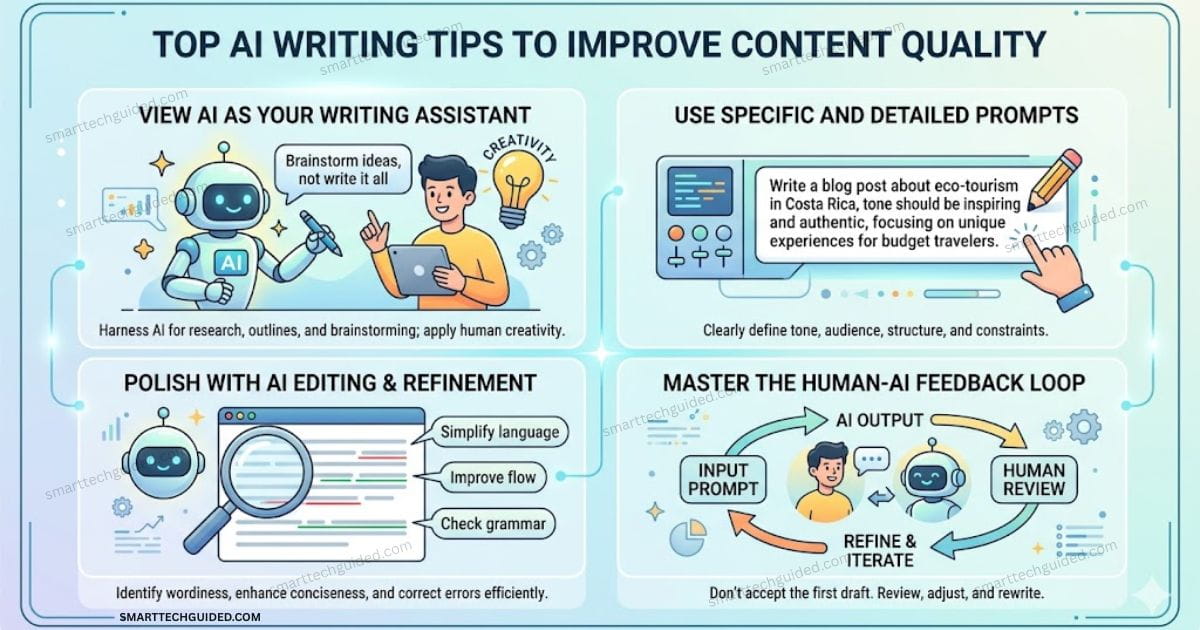
Writing well with AI is not just about speed; it’s about creating high-quality content that informs, engages, and resonates. By following specific tips, you can make AI a powerful partner in improving your content while maintaining your unique voice.
Focus on clarity, value, and personal insights when using AI. Edit carefully and combine AI output with your experience for the best results. Here are several AI writing tips.
1. Write Clear and Specific AI Prompts
The quality of AI-generated content depends on how clearly you communicate your instructions. Specific prompts guide AI to generate useful suggestions rather than generic text. So, it will ensure that the AI output aligns with your goals.
Tips for better prompts:
- Include context, tone, and format: “Write a 300-word blog intro in a friendly tone about AI writing tips.”
- Ask for lists, examples, or summaries instead of full drafts.
- Be precise about audience and purpose.
2. Edit and Refine AI-Generated Content
AI can draft, suggest alternatives, or polish sentences, but human review is essential. Always refine grammar, flow, and tone to ensure your content is clear, engaging, and accurate.
Key steps:
- Check for readability and coherence.
- Remove generic phrasing and add your own insights.
- Maintain consistent voice and tone throughout.
3. Focus on Value, Not Just Speed
AI can make writing faster, but speed alone doesn’t create impact. Prioritize content that solves problems, educates, or entertains your readers.
Tips:
- Answer common questions your audience has
- Use examples, statistics, or anecdotes for credibility.
- Avoid rushing; review the content for accuracy and depth.
4. Add Your Personal Experience to AI Content
The human touch makes AI-generated content authentic. Include your own examples, stories, or insights to make the content memorable and trustworthy.
Ways to add personal experience:
- Share lessons learned from projects or experiments
- Include real-life case studies or examples.
- Reflect on how AI influenced your writing process.
Combining AI efficiency with your expertise and voice improves content quality and authority.
Common Mistakes to Avoid When Using AI for Writing
Even though AI can speed up writing, misusing it can reduce content quality. It is like a conversation with your AI chatbot. If you clearly state what you need, you may get a good result. Avoid these common mistakes to ensure your writing stays professional, engaging, and authentic.
AI is a tool, not a replacement. Avoid over-reliance, preserve your voice, and always review AI-generated content. Here are a few mistakes new writers make, along with how AI tips can help improve their content.
1. Copying AI Content Without Editing
Simply copying AI output can make content generic, repetitive, or even factually incorrect. Always review and edit AI suggestions to:
- Ensure accuracy and originality.
- Maintain your unique voice.
- Add context, examples, or personal insights.
2. Relying Too Much on AI
Over-dependence on AI limits creativity and critical thinking. Use AI as support, not a replacement for your ideas. Keep:
- Brainstorming and planning in human hands
- Drafting critical sections yourself
- Reflection and editing steps
3. Ignoring Tone, Audience, and Intent
AI can produce grammatically correct text, but it may miss tone, context, or purpose, since many tools already tell us our content may have mistakes. Always ensure content matches:
- Audience expectations
- Brand voice
- Communication intent
Real Examples of Using AI in Content Writing
AI can significantly enhance real-world writing by providing structured suggestions, creative prompts, and time-saving edits. For instance, bloggers, marketers, and technical writers can use AI to generate outlines, refine drafts, or summarize complex ideas, all while maintaining their unique voice and perspective.
- Bloggers use AI to draft outlines, then expand with personal stories.
- Marketing teams generate headline options and A/B test them.
- Technical writers summarize complex topics and refine them for clarity.
These examples show AI’s supportive role, helping writers save time while maintaining quality.
How to Improve Your Writing Skills Alongside AI
AI can’t replace consistent practice. By following these AI writing tips, you can strengthen your skills, refine your voice, and make the most of AI as a supportive writing tool. Practicing regularly alongside AI ensures your content stays original, engaging, and impactful.
- Read widely: Explore different styles and formats.
- Practice regularly: Combine AI suggestions with your own drafts
- Study editing: Learn to refine AI content for clarity and impact
- Reflect on feedback: Analyze AI-assisted work to identify areas for improvement.
Pairing AI with consistent skill-building ensures your writing stays original, engaging, and authoritative.
Wrap Up
In short, AI is a smart writing partner, and by following these AI writing tips, you can make the most of its capabilities, but the real magic still comes from your human touch. Start with your own ideas, use AI to brainstorm, create outlines, and polish your drafts, and always refine the content with your personal insights and experience. When used responsibly, AI helps you write faster, stay organized, and produce high-quality content all while keeping your unique voice at the center.
Ready to take your writing to the next level? Start using AI today and see how it can make your content creation smoother, smarter, and more enjoyable!








Leave a Reply