
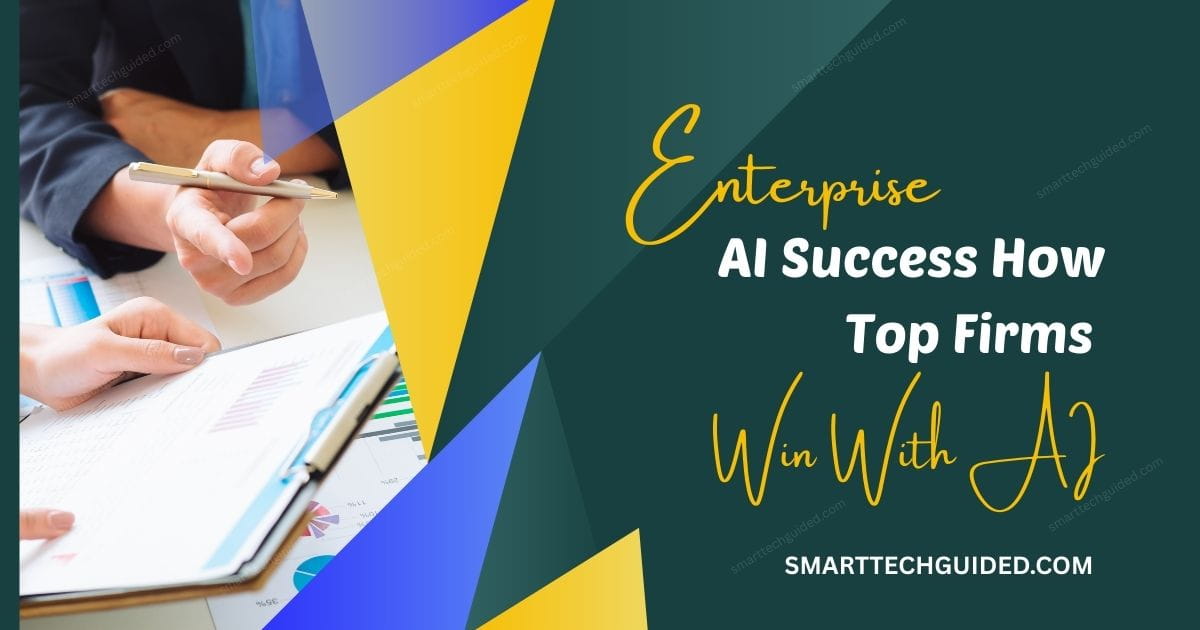
Artificial intelligence is no longer futuristic; it’s transforming how businesses operate and compete. Enterprise AI helps organisations automate processes, reduce costs, and uncover new growth opportunities through data-driven insights.
The real advantage comes from using AI strategically. Leading companies align Enterprise AI with business goals, integrate data across teams, and build a culture of innovation and continuous learning. They also prioritise ethics and adopt AI to build trust.
By adopting the right Enterprise AI strategy, businesses can improve efficiency, enhance decision-making, and gain a strong competitive advantage in today’s fast-paced digital economy.
Understanding Enterprise AI’s Role in Business Transformation
Artificial intelligence is no longer just replacing traditional tools; it is transforming how modern businesses operate. By integrating Enterprise AI into core workflows, organisations can automate complex processes, reduce manual effort, and improve operational efficiency. This shift allows teams to focus on high-value tasks, boosting productivity and driving smarter business outcomes.
Beyond automation, Enterprise AI enables companies to analyse large volumes of data in real time. From customer behaviour and market trends to operational performance, AI delivers actionable insights that support faster, data-driven decision-making. Businesses that succeed treat AI not as a one-time upgrade, but as a long-term strategic asset.
By embedding Enterprise AI across operations, analytics, and customer experience, organisations can innovate continuously, improve agility, and unlock sustainable growth in today’s competitive digital landscape.
Why Some Enterprises Excel with Enterprise AI
Leading organisations don’t just adopt technology; they strategically implement Enterprise AI to drive measurable business results. In retail, AI optimises inventory, predicts demand, and delivers personalised customer experiences, boosting sales and loyalty. Automotive firms use AI to speed product design, improve testing, and ensure higher-quality vehicles.
Manufacturers rely on Enterprise AI for predictive maintenance, reducing downtime and increasing operational efficiency, while industrial and agricultural companies deploy AI-driven automation to enhance productivity and minimise waste.
What sets top enterprises apart is a focus on outcomes, not tools. By embedding Enterprise AI into core processes and aligning initiatives with strategic goals, businesses innovate faster, achieve tangible results, and stay ahead in competitive markets.
Key Strategies for Enterprise AI Success
Top enterprises achieve success by embedding Enterprise AI into their core operations. Integrating AI into everyday processes ensures that insights are actionable, decisions are faster, and workflows continuously improve. This strategy transforms AI from a mere support tool into a driver of innovation, efficiency, and sustainable business growth.
1. Embed AI in Core Operations
Leading organisations design processes with AI at the centre, enabling real-time data analysis and faster, more informed decision-making. By continuously learning from operations and optimising workflows, Enterprise AI becomes a strategic growth engine rather than a standalone technology. This approach ensures companies remain agile, innovative, and competitive in rapidly evolving markets.
2. Build AI Skills Across Teams
Success in Enterprise AI depends on people just as much as technology. Leading companies invest in training employees on AI tools, building cross-functional teams, and fostering collaboration between technical experts and business units.
By upskilling teams, organisations ensure that AI solutions are implemented effectively and creatively. Employees become capable of interpreting AI insights, optimising workflows, and contributing to innovation. This human-centred approach maximises the value of Enterprise AI, turning technology into a strategic asset that drives growth, improves decision-making, and empowers the workforce to tackle complex business challenges.
3. Use AI for Data-Driven Decisions
Enterprise AI empowers organisations to turn complex data into actionable insights, helping leaders make smarter, faster decisions. By analysing patterns and trends, AI enables companies to forecast market shifts, optimise operations, and identify opportunities and potential risks before they escalate.
With clean, well-integrated data and AI-driven analytics, enterprises can move from reactive decision-making to proactive strategies. This ensures decisions are not only faster but also more accurate and aligned with business goals.
Leveraging Enterprise AI for data-driven insights transforms information into a competitive advantage, allowing organisations to innovate confidently, reduce inefficiencies, and stay ahead in today’s dynamic marketplace.
Overcoming Enterprise AI Challenges in Modern Organisations
While Enterprise AI delivers significant benefits, adopting it comes with challenges that organisations must address to succeed. Poor data quality or fragmented system integration can lead to inaccurate insights, limiting AI’s effectiveness. Skill gaps also pose barriers; teams need proper training to implement AI confidently.
Legacy IT systems can restrict AI capabilities, making modernisation essential. Ethical considerations are equally critical: AI must be transparent, fair, and aligned with organisational values.
Enterprises that proactively tackle these challenges by improving data quality, upskilling staff, modernising infrastructure, and adopting responsible AI practices gain lasting advantages.
Thoughtful Enterprise AI adoption enhances agility, strengthens decision-making, and positions companies ahead of competitors, turning potential obstacles into strategic growth opportunities.
Real World Examples of Enterprise AI Wins
Enterprise AI is delivering measurable results across industries. Retailers like Walmart use AI to forecast demand, optimise inventory, and streamline supply chains, improving efficiency and customer satisfaction. Sephora leverages AI personalisation to boost engagement and sales.
In automotive, Tesla and Ford apply AI to speed vehicle design, enhance testing, and improve product quality. Manufacturers like Siemens use predictive analytics to prevent equipment failures and reduce downtime. Agriculture benefits too. John Deere employs AI for precision farming, improving crop yields and minimising resource waste.
These examples show that strategic Enterprise AI adoption drives innovation, efficiency, and growth, giving organisations a competitive edge.
The Future of Enterprise AI
The future of Enterprise AI is full of potential, but success will favour organisations that implement it strategically. Leading companies align AI initiatives with core business goals, ensuring technology delivers measurable value rather than operating in isolation.
Investing in workforce skills and fostering cross-functional talent enables teams to use AI effectively, while embedding AI into everyday operations transforms processes, decision-making, and innovation. Continuous monitoring, measurement, and iteration help refine strategies and maximise outcomes.
When approached thoughtfully, Enterprise AI becomes more than a tool; it’s a driver of efficiency, innovation, and sustainable competitive advantage. Organisations that embrace these strategies can adapt to the evolving AI landscape and turn potential into real business results.
Wrap Up
Enterprises that thrive in the AI era don’t just adopt technology; they integrate Enterprise AI thoughtfully into operations, empower teams, and focus on measurable outcomes. AI chatbot conversation is alone a magic solution; when applied strategically, it streamlines processes, drives growth, and delivers lasting competitive advantages.
Success requires careful planning, alignment with business goals, and disciplined execution. Organisations that combine intelligent technology with human expertise are best positioned to innovate, outpace competitors, and lead the next wave of transformation. By embracing this balanced approach, Enterprise AI becomes a catalyst for sustainable business success and long-term value.
FAQ’s
Q1. What is enterprise AI?
Enterprise AI refers to the use of artificial intelligence technologies within organisations to improve business operations, decision-making, and efficiency. It is designed to handle large-scale data, integrate with existing systems, and automate complex processes like customer service, supply chains, and analytics. Unlike basic AI tools, enterprise AI focuses on reliability, security, and scalability. It helps businesses gain insights and stay competitive.
Q2. What is the difference between generative AI and enterprise AI?
Generative AI creates new content such as text, images, or code based on patterns learned from data, while enterprise AI focuses on solving business problems and optimising operations.
Generative AI is often used for creativity and automation of content, whereas enterprise AI is used for decision-making, forecasting, and process efficiency. In simple terms, generative AI produces, while enterprise AI manages and improves business performance.
Q3. What are the 7 types of AI?
The 7 types of AI are commonly grouped into: Reactive Machines, Limited Memory, Theory of Mind, and Self-aware AI (based on capability), along with Narrow AI, General AI, and Super AI (based on functionality). Most AI today falls under Narrow AI and Limited Memory, meaning it performs specific tasks using past data. Advanced types like General AI and Self-aware AI are still theoretical and not yet fully developed.
Q4. What is the best enterprise AI?
There is no single “best” enterprise AI, as it depends on business needs, industry, and scale. Leading platforms include solutions from companies like IBM, Microsoft, and Google, which offer tools for automation, analytics, and machine learning.
The best choice is one that integrates easily, ensures data security, and delivers measurable business value. Organisations should choose based on their specific goals and infrastructure.



Leave a Reply