
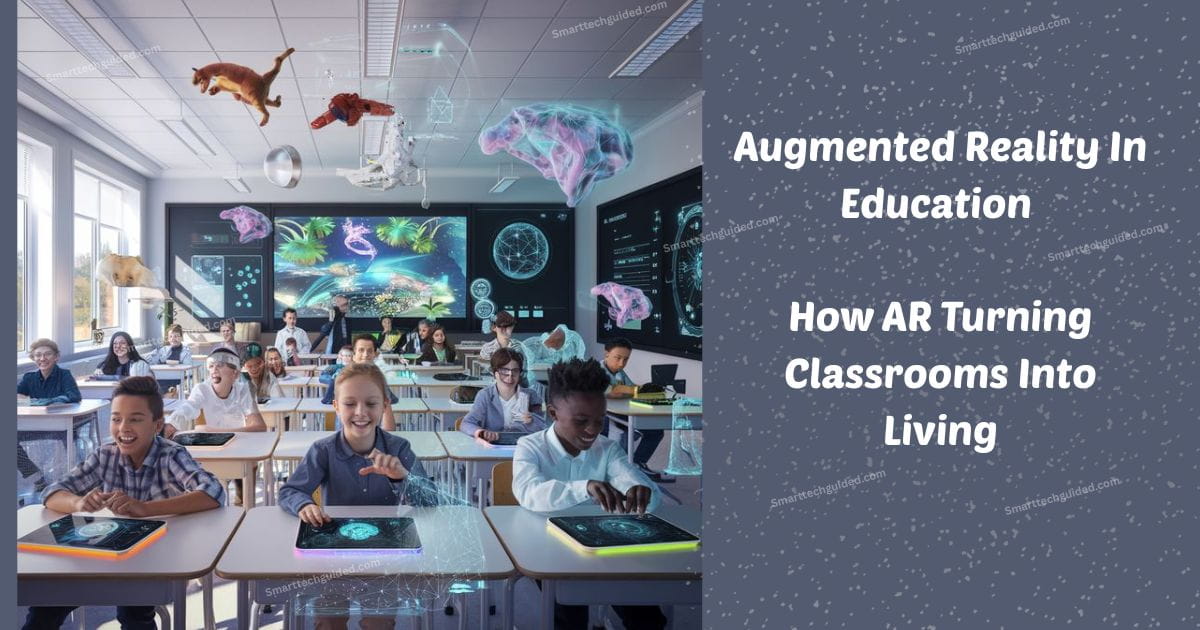
Remember that moment when a lesson finally “clicked”? Not because you read it, but because you saw it, touched it, or experienced it firsthand. That spark of understanding that “aha” moment is exactly what augmented reality in education brings to students today.
Gone are the days of memorizing facts from flat pages or listening passively to lectures. With AR, learners can explore a beating human heart right on their desks, walk through the streets of ancient cities without leaving their classroom, and solve complex math problems with interactive visual guides floating in front of them. Science experiments unfold safely in 3D, history comes alive, and abstract concepts become tangible.
This isn’t just a passing trend it’s a revolutionary shift in how we learn, remember, and apply knowledge. Schools and universities are adopting augmented reality in education to make lessons more immersive, engaging, and effective. In this guide, we’ll explore how AR is transforming classrooms, its benefits for students and teachers, and practical ways it’s reshaping modern education.
What Is Augmented Reality in Education?
Augmented reality (AR) blends digital content seamlessly into the real world using devices like smartphones, tablets, or smart glasses. In classrooms, this technology transforms learning from passive observation to hands-on exploration. Imagine a 3D human heart appearing right on a student’s desk, a solar system floating above a textbook, or a geometry problem turning into a visual shape that learners can rotate, move, and explore. Instead of just reading about concepts, students interact with them directly, making learning more intuitive and memorable.
This is the true power of augmented reality in education it turns abstract, hard-to-grasp ideas into interactive, immersive experiences. By visualizing and manipulating concepts, students gain a deeper understanding, retain information longer, and enjoy the process of learning like never before.
Why Traditional Learning Often Falls Short
Many classrooms still rely on textbooks, slides, lectures, and worksheets. While these methods provide information, they often demand students imagine concepts that can be abstract or complex. Not every student learns effectively by reading or listening alone some need to see, touch, and interact to truly grasp the material.
This is where augmented reality in education makes a real difference. AR bridges the gap between theory and experience, transforming passive learning into active exploration. Students can manipulate 3D objects, visualize scientific processes, or walk through historical sites without leaving the classroom. By making lessons interactive and immersive, AR helps students understand difficult concepts faster, remember them longer, and enjoy the learning process in a way traditional methods rarely achieve.
How Augmented Reality Helps Students Learn Better
1. It Makes Learning Visual
When students interact with a 3D model instead of a flat 2D diagram, their brains understand and retain information more quickly.
For example:
- Biology students can explore organs layer by layer, seeing how each part connects.
- Geography students watch mountains rise and rivers flow from maps.
- Chemistry students observe molecules forming and breaking apart in real time.
This hands-on, visual approach makes complex concepts easier to grasp, reduces confusion, and helps students remember what they learn long after the lesson ends.
2. It Improves Memory and Focus
We remember experiences far better than plain words or text. Augmented reality in education turns lessons into interactive moments that stick in students’ minds.
Research shows that learners retain more when they:
- Interact directly with content
- Move around and explore concepts
- Make decisions during the learning process
By engaging multiple senses, AR transforms abstract material into real experiences. Instead of just memorizing facts, students truly understand and remember what they learn. Lessons become moments, not just material.
3. It Helps Different Learning Styles
Not every student learns the same way, and that’s what makes a classroom diverse. Augmented reality in education creates space for all learning styles to thrive. Visual learners can see concepts come to life through 3D models and animations. Kinesthetic learners can move, explore, and interact with objects instead of sitting still. Auditory learners benefit from guided explanations and narrated lessons built into AR experiences. By supporting multiple ways of learning at once, AR makes classrooms more inclusive, balanced, and engaging for every type of student.
Real World Examples of Augmented Reality in Education
Let’s step inside real classrooms where learning feels more like an experience than a lesson. Students use tablets to scan textbook pages and instantly see 3D models, animations, and interactive guides appear. From virtual science labs to historical landmarks in the classroom, augmented reality in education turns everyday lessons into hands-on discovery.
1. Biology Exploring the Human Body in 3D
Instead of memorizing flat diagrams, students can step inside the human body and explore it in a whole new way. With augmented reality in education, they can rotate a beating heart, zoom into tiny blood vessels, and watch lungs expand and contract in real time. This hands-on experience turns anatomy into a journey of discovery rather than a list of facts. By seeing how each system works together, students build deeper understanding, stronger memory, and genuine curiosity about how the human body functions.
2. History Walking Through the Past
With augmented reality in education, history stops feeling like a list of dates and names and starts to feel like a real place you can step into. Students can visit the streets of ancient Rome, stand inside towering Egyptian pyramids, and watch historical battles unfold right on their desks. By experiencing events visually, learners connect emotionally with the past and remember lessons more naturally.
3. Math Seeing Numbers in Motion
Augmented reality in education turns numbers into something students can actually see and move. Geometry shapes float in the air, angles can be rotated from every direction, and measurements appear clearly in real space. This visual, hands-on approach helps students who struggle with abstract concepts understand math in a practical, confident way.
4. Science Safe, Interactive Experiments
Augmented reality in education lets students run experiments without fear of spills, burns, or broken equipment. They can mix virtual chemicals, test physics laws, and explore scientific reactions in real time. This hands-on, risk-free environment encourages curiosity, builds confidence, and helps learners understand complex concepts through safe, interactive discovery.
Language Learning : Words in the Real World
Augmented reality in education transforms language learning from memorizing vocabulary lists into living, breathing experiences. Students can point their phones or tablets at everyday objects around the classroom and instantly see translations, hear correct pronunciations, and view example sentences that show how each word is used in real-life situations. This direct connection between words and the physical world helps learners build stronger mental links, making new languages easier to recall and apply.
Instead of repeating flashcards, students can “walk” through a space and discover language naturally. A chair becomes a lesson in nouns, adjectives, and sentence structure. A window introduces verbs, prepositions, and descriptive phrases. Teachers can even design AR scavenger hunts where learners find objects, listen to audio guides, and complete short speaking tasks. This approach boosts confidence, improves pronunciation, and encourages students to practice without the fear of making mistakes, turning the classroom into an interactive language playground rather than a traditional study hall.
How Teachers Use AR in Daily Lessons
Augmented reality in education doesn’t replace teachers it amplifies what they already do best. Instead of standing at the front and delivering long explanations, educators become guides who lead students through meaningful learning experiences. Teachers use AR to introduce complex topics with clear, visual demonstrations, helping students grasp difficult ideas within minutes rather than hours.
In daily lessons, AR-powered quizzes turn assessments into interactive challenges where students explore models, tap on objects, and answer questions in real time. Virtual projects allow learners to build 3D models, recreate historical scenes, or design science experiments together, encouraging teamwork and creativity. Group exploration activities push students to discuss what they see, share insights, and solve problems as a team.
This shift changes the classroom dynamic. Students take an active role in their learning, while teachers focus on mentoring, supporting, and asking the right questions. The result is a more engaging, confident, and curious classroom culture.
The Technology Behind AR in Schools
Augmented reality in education is built on tools many classrooms already have, which makes adoption easier than most people expect. At its core, AR runs smoothly on everyday smartphones and tablets, using their cameras and sensors to place digital objects into the real world. Teachers also connect AR apps to classroom projectors or smart boards, allowing the entire class to view and interact with the same 3D models together.
In more advanced learning environments, schools experiment with AR glasses and head-mounted displays to create fully immersive lessons. These tools let students move around a space while virtual content stays anchored in place, deepening the sense of realism.
What makes this technology so powerful is its accessibility. Schools don’t need expensive labs or complex installations. Many AR platforms work on devices students already own, making it possible to bring interactive, high-impact learning into both classrooms and home study with minimal cost.
Benefits of Augmented Reality in Education
Augmented reality isn’t just for school classrooms universities and professional training programs are embracing it too. AR lets students and trainees practice skills in a safe, interactive environment before stepping into the real world.
For example:
- Medical Training: Students explore 3D organs, perform virtual surgeries, and understand anatomy in depth without risks.
- Engineering Simulations: Complex machinery or circuits can be visualised and tested virtually, making learning hands-on and precise.
- Architecture Visualisation: Designs come to life in 3D, allowing students to walk through buildings before construction.
- Technical Skill Practice: Trainees can safely learn procedures, repair equipment, or operate tools in a controlled AR environment.
With AR, learners gain practical experience, make mistakes safely, and build confidence—turning theory into real-world readiness. It’s like practicing the future before it happens.
Challenges Schools Face With AR
While augmented reality in education offers incredible opportunities, schools do face some challenges when implementing it.
- Limited Access to Devices: Not all students have smartphones, tablets, or AR-enabled devices.
- Teacher Training Needs: Educators need guidance to integrate AR effectively into lessons.
- Internet Connectivity Issues: Many AR apps require stable internet, which can be a barrier.
- App Compatibility: Not all AR applications work across every device or operating system.
Despite these challenges, the situation is improving. Devices are becoming more affordable, AR apps are easier to use, and teacher training programs are expanding. With thoughtful planning, schools can overcome these obstacles and bring immersive learning experiences to every student. AR is no longer a futuristic idea—it’s becoming a practical, scalable tool for modern classrooms.
How Schools Can Start Using AR Today
Start small by using free AR apps on student devices, focus on one subject first, train teachers gradually, and gather feedback to make lessons interactive, engaging, and effective.
Simple Steps for Beginners
- Start with Free AR Apps: Explore educational apps that are easy to download and use.
- Use Student Smartphones or Tablets: Leverage devices students already own to minimize costs.
- Introduce AR in One Subject First: Focus on a single topic like science or history before expanding.
- Train Teachers Gradually: Provide short workshops or tutorials so educators feel confident using AR.
- Collect Student Feedback: Ask learners what works and what can improve to guide future lessons.
AR doesn’t require a complete classroom overhaul. By introducing it gradually, schools can create interactive, engaging experiences without overwhelming teachers or students. Starting small ensures lessons are effective, fun, and easy to manage, making AR a practical tool for enhancing education.
AR vs Traditional Learning: A Quick Comparison
| Feature | Traditional Learning | AR Learning |
|---|---|---|
| Engagement | Passive | Interactive |
| Visualisation | Limited | 3D & immersive |
| Learning Speed | Moderate | Faster |
| Student Participation | Low | High |
| Retention | Medium | Strong |
FAQs
How is augmented reality used in classrooms?
AR brings lessons to life by showing 3D models, running virtual experiments, and creating interactive activities using smartphones, tablets, or AR-enabled devices, helping students explore concepts hands-on and engage deeply with the material.
Does AR really improve learning?
Yes. AR boosts understanding, engagement, and retention by turning abstract concepts into visual, interactive experiences, allowing students to experiment, explore, and remember lessons more effectively than traditional methods alone.
Which subjects benefit most from AR?
Science, math, biology, history, geography, and language learning benefit the most, as AR transforms complex ideas into visual, interactive, and practical experiences, making lessons easier to grasp and remember.
Do schools need expensive equipment for AR?
Not necessarily. Many AR apps work on existing smartphones or tablets, enabling schools to implement AR affordably without costly devices or special setups.
Can AR support different learning styles?
Absolutely. Visual, kinesthetic, and auditory learners benefit as AR combines sight, sound, and movement, creating an inclusive, engaging, and effective learning environment.
Sum Up
Technology can sometimes distract students, but augmented reality in education turns it into a powerful learning tool. By blending digital content with the real world, AR helps students see, touch, and interact with concepts, making lessons more engaging and easier to understand. From exploring the human body in 3D to walking through historical landmarks, AR transforms abstract ideas into experiences. This hands-on approach improves memory, focus, and comprehension while supporting different learning styles. When students feel curious and involved, they don’t just memorise facts they enjoy learning, retain knowledge longer, and develop a deeper connection with the subject.




Leave a Reply