
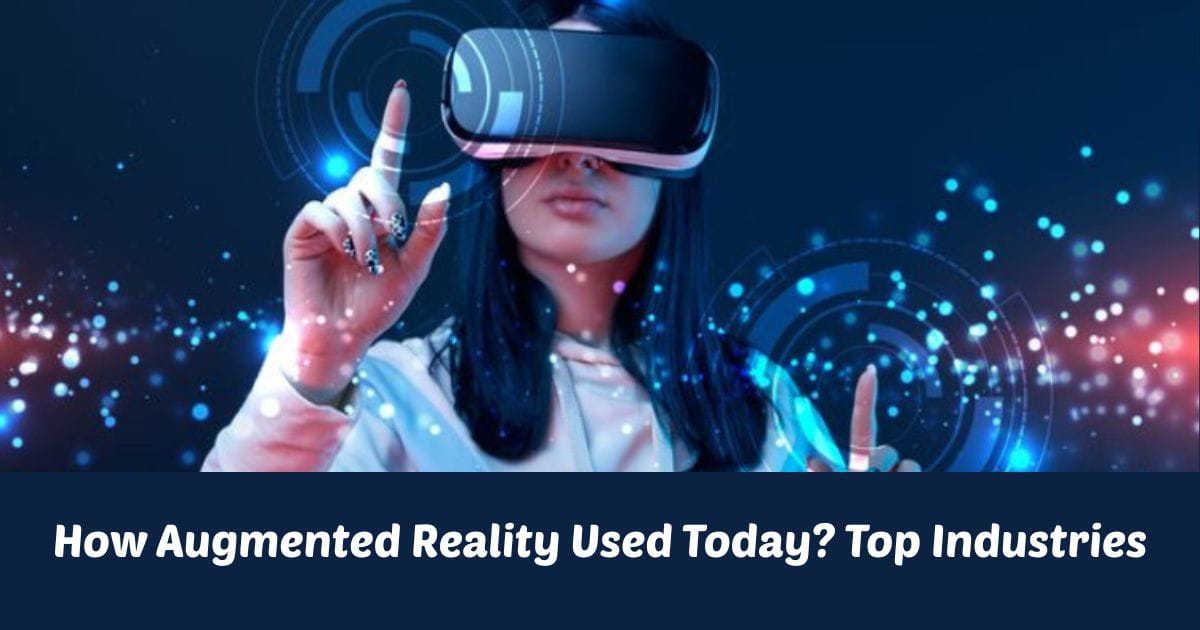
Augmented Reality Used in real life isn’t just about fun filters or games it’s transforming the way we live and work. From helping doctors perform precise surgeries to letting students learn faster, from guiding shoppers to smarter choices to enabling workers to repair machines with confidence, AR is everywhere. It’s no longer a futuristic idea. Augmented reality lives in your phone, your classroom, your car, and even your workplace, quietly making tasks easier, faster, and more interactive.
In this guide, we’ll explore how augmented reality is used across industries, why businesses and schools are adopting it so quickly, and how AR is reshaping learning, productivity, and everyday experiences. So, Let’s dive into the industries where reality itself is getting a modern upgrade.
What Is Augmented Reality Used For?
At its simplest, augmented reality (AR) used in adds digital elements to the real world, enhancing what you see instead of replacing it. AR blends virtual information seamlessly with physical objects, turning ordinary experiences into interactive and immersive ones.
These enhancements can include:
- Visual: 3D models, arrows, labels, or animations that appear in real space to guide or explain.
- Informational: Live stats, instructions, measurements, or other data overlaid on what you see.
- Interactive: Users can touch, move, rotate, or explore digital objects as if they were real.
For example, a technician repairing a machine might see step-by-step instructions hovering directly over the components, reducing errors and training time. Students can watch the solar system spin on their desk, rotate molecules in chemistry, or explore historical sites in 3D. Even shoppers can point their phones at products to see prices, reviews, or features instantly.
In short, augmented reality used to make learning, working, and everyday tasks more engaging, accurate, and efficient. It turns passive observation into active interaction, helping people understand and do more with the world around them.
1.Turning Education Lessons Into Experiences
Classrooms are no longer limited to textbooks and whiteboards. With augmented reality in education, lessons become interactive experiences that students can see, touch, and explore.
Using AR apps, students can:
- Explore 3D human anatomy: Rotate organs, zoom into blood vessels, and understand complex systems layer by layer.
- Walk through ancient cities: Step inside historical sites, watch events unfold, and experience history firsthand.
- Solve math problems visually: Geometry shapes float in the air, angles can be rotated, and abstract concepts become easier to grasp.
- Watch science experiments safely: Mix chemicals, simulate reactions, and test theories without any risk.
Schools use AR because it:
- Improves memory and focus by turning lessons into interactive moments.
- Helps visual and kinesthetic learners understand concepts faster.
- Makes abstract ideas tangible, transforming understanding from memorisation into real-world comprehension.
In short, AR makes learning an experience, not just something you read or hear.
2. Healthcare – That Saves Lives
Augmented reality isn’t just futuristic it’s already transforming hospitals and clinics. AR allows medical professionals to work with unmatched precision and efficiency, making procedures safer and training more effective.
Doctors and nurses use AR to:
- Locate veins and arteries under the skin for accurate injections or surgeries.
- Monitor patient vitals in real time during operations without looking away.
- Practice complex procedures on 3D models before performing them on real patients.
- Train new staff safely with virtual simulations, reducing mistakes and building confidence.
This is a perfect example of how augmented reality used in real life it directly enhances patient care, speeds up decision-making, and increases accuracy. In healthcare, AR doesn’t just teach or visualize—it saves lives.
3. Retail & E-Commerce
Shopping isn’t just about browsing anymore augmented reality used to transform how customers interact with products. AR lets shoppers see, try, and experience items before making a purchase, bridging the gap between online and in store shopping.
With AR, customers can:
- Try on glasses, makeup, or shoes virtually to see how they look in real time.
- Place furniture or decor in their room to check size, style, and fit.
- Visualise product sizes, colours, and features under real lighting conditions before buying.
Businesses love AR because it:
- Builds customer confidence by helping them make informed decisions.
- Reduces product returns by minimizing mismatches or mistakes.
- Encourages longer browsing and increases engagement with products.
This is how augmented reality used in e – commerce turning shopping from passive scrolling into a hands-on, interactive experience.
4. Manufacturing: Smarter Work, Fewer Mistakes
On factory floors, augmented reality acts like a silent guide, helping workers perform tasks with precision and confidence. AR overlays digital instructions onto real machinery, making complex processes easier and safer.
Workers use AR through smart glasses or tablets to:
- Follow step-by-step assembly guides directly on the equipment.
- See real-time safety warnings to avoid accidents.
- Monitor machine performance and diagnostics instantly, preventing errors.
The results are clear: fewer mistakes, faster training for new employees, and smoother operations even with complex systems. By providing instant guidance and information, augmented reality used in manufacturing to improve both productivity and safety, transforming how modern factories operate.
5. Real Estate & Architecture
Before a building even exists, augmented reality allows people to step inside it virtually. AR transforms blueprints and floor plans into immersive, 3D experiences, helping buyers, architects, and designers make smarter decisions.
Agents and architects use AR to:
- Show full-scale 3D home designs that clients can explore room by room.
- Visualise renovations and remodels before committing to changes.
- Test lighting, layouts, and furniture placement in real-time to see what works best.
With AR, buyers don’t just imagine a property they experience it. This makes decision-making easier, reduces mistakes, and enhances client confidence. In real estate and architecture, augmented reality is used to bring ideas to life long before the first brick is laid.
6. Marketing & Advertising
Traditional ads often interrupt your day, but augmented reality turns advertising into an interactive experience. AR lets brands engage customers in ways that are fun, memorable, and immersive.
Brands use AR to:
- Let users try products virtually directly from social media or apps.
- Create interactive billboards and posters that respond to movement or touch.
- Launch immersive campaigns where audiences can explore, play, and interact with the brand.
Instead of passively watching an ad, people actively engage with it, increasing attention, recall, and interest. In marketing, augmented reality is used to transform ordinary campaigns into experiences that connect with customers in meaningful, memorable ways.
7. Navigation & Travel
Getting lost is quickly becoming a thing of the past thanks to augmented reality. AR makes navigation intuitive by overlaying directions and information directly onto the real world, turning every journey into a guided experience.
With AR navigation, users can see:
- Arrows on sidewalks and streets guiding them turn by turn.
- Building names and labels instantly overlaid on real structures.
- Distance markers and points of interest in real space for better orientation.
Tourism apps take it further by bringing landmarks to life, providing stories, translations, and historical context as visitors explore. In short, augmented reality used in navigation and travel to make exploring cities and new places easier, smarter, and far more engaging, turning everyday trips into interactive adventures.
8. Gaming & Entertainment
Augmented reality takes gaming and entertainment beyond screens, blending the digital world with your physical space. AR turns imagination into action, making experiences interactive and immersive.
In gaming, players can:
- Catch virtual creatures in parks or neighbourhoods
- Play tabletop or board games on their living room floors
- Interact with characters and objects as if they were real
In entertainment, AR enhances live events by allowing broadcasters to:
- Show real-time sports stats during games
- Visualise plays and strategies on the field
- Enhance concerts or performances with interactive effects
In short, augmented reality used to make gaming and entertainment more engaging, turning viewers into active participants and making every experience memorable and interactive.
9. Automotive Driving With Digital Assistance
Augmented reality is revolutionizing how we drive, making roads safer and journeys smarter. AR overlays crucial information directly onto the driver’s view, reducing distractions and helping make quicker, better decisions.
Modern vehicles use AR for:
- Head-up displays (HUD): Show speed, directions, and alerts without looking away from the road
- Parking guidance: Visual cues help drivers park safely in tight spots
- Safety alerts: Highlight pedestrians, hazards, or lane departures in real time
- Navigation overlays: Turn-by-turn directions appear right on the windshield
With AR, drivers can focus on the road while essential data floats seamlessly in their line of sight. In everyday driving, augmented reality used to enhance safety, convenience, and overall control, creating a smarter, more responsive driving experience.
10. Logistics & Warehousing
In large warehouses and distribution centres, augmented reality used to helps workers move faster, work smarter, and make fewer mistakes. AR overlays digital information onto the real environment, guiding staff efficiently through complex operations.
Workers use AR to:
- Locate items quickly by following visual cues and highlighted paths
- Follow optimized picking routes for faster order fulfillment
- Verify shipments visually to reduce mistakes before dispatch
By reducing training time and minimizing errors, AR makes warehouse operations more efficient, reliable, and accurate. In supply chains, augmented reality is used to boost productivity, cut costs, and improve overall workflow, ensuring goods move smoothly from storage to delivery.
Why Industries Are Investing in Augmented Reality
The true power of augmented reality isn’t just the technology it’s the confidence it gives people to act with precision. By overlaying digital information onto the real world, AR helps employees, students, and customers make smarter choices instantly.
Top benefits of augmented reality used in business and everyday life include:
- Faster learning: Users understand tasks and concepts more quickly
- Better decisions: Visual guidance reduces guesswork
- Fewer mistakes: Real-time instructions prevent errors
- Higher engagement: Interactive experiences capture attention
- Stronger customer trust: Transparency and clarity improve satisfaction
When people can see exactly what to do, they don’t just guess they perform tasks correctly and efficiently. This is why businesses across healthcare, education, retail, and manufacturing are rapidly adopting augmented reality used to boost productivity, safety, and customer experience.
FAQs
What industries use augmented reality the most?
Education, healthcare, retail, manufacturing, marketing, real estate, and automotive are leading the way. These industries use AR to improve learning, safety, efficiency, and customer experiences.
Is augmented reality used in everyday life?
Absolutely. AR appears in navigation apps, social media filters, online shopping tools, home design apps, and car displays, making daily tasks more interactive and intuitive.
How does augmented reality help businesses?
AR enhances employee training, reduces mistakes, boosts productivity, increases customer engagement, and builds trust by giving real-time guidance and interactive experiences.
Can AR improve learning for students?
Yes. By turning abstract concepts into visual, interactive experiences, AR helps students understand faster, retain knowledge longer, and enjoy learning more.
Do businesses need expensive equipment for AR?
Not always. Many AR solutions work on smartphones, tablets, or smart glasses, making it accessible even for small companies.
Sum Up
Augmented reality isn’t just a tech trend—it’s a tool that makes everyday life easier and more intuitive. It doesn’t force you to work harder; it helps you work smarter. It doesn’t make learning longer; it makes understanding faster. It doesn’t complicate shopping; it makes decisions clearer. That’s why AR is being adopted across industries faster than almost any other technology. From education and healthcare to retail and manufacturing, AR enhances experiences, reduces mistakes, and boosts confidence. The beauty of AR is how seamlessly it integrates into your world. The more it becomes part of your daily life, the less you notice the technology and the more you notice the results smarter actions, faster learning, and more meaningful experiences. Augmented reality is no longer the future it’s your world, enhanced.




Leave a Reply