
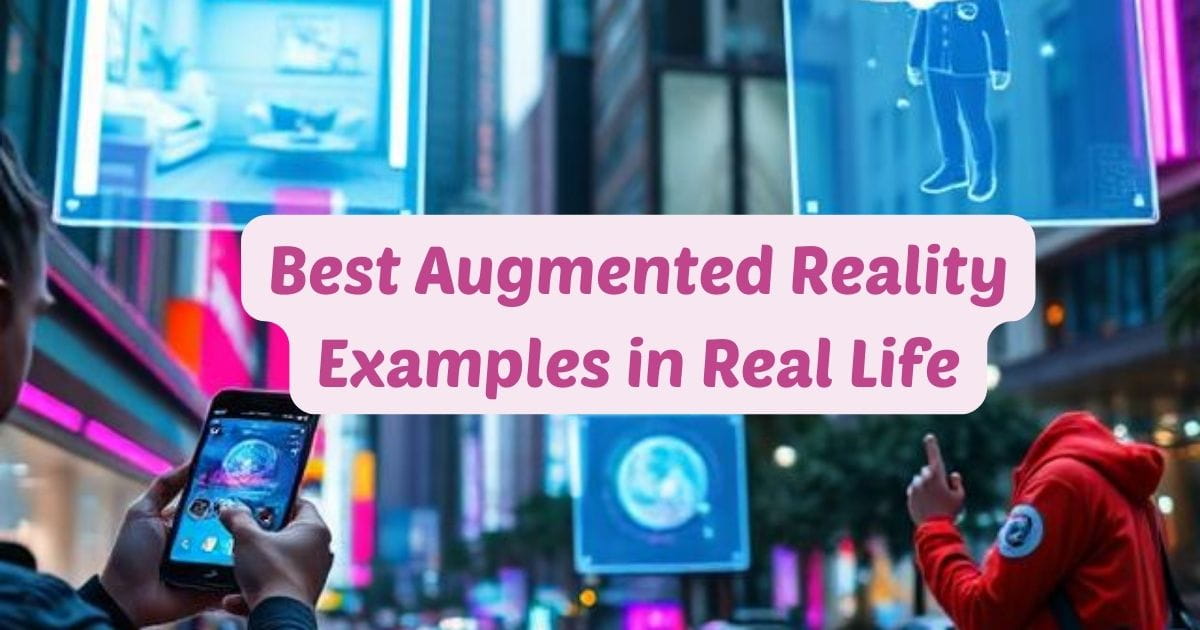
Have you ever pointed your phone at a street and watched directions appear on the ground like magic? Or tried on shoes without stepping into a store? That’s not the future. That’s augmented reality in real life and it’s already part of your everyday world.
In this guide, you’ll discover the most powerful augmented reality examples you can actually use today. No tech jargon. No hype. Just real-world stories, practical use cases, and simple explanations that show how AR quietly transforms how you learn, shop, travel, work, and play. Let’s step into the real world with a digital layer on top.
What Are Augmented Reality Examples in Real Life?
Before we jump into the list, let’s ground ourselves.
Augmented reality (AR) blends digital elements images, sounds, or data into your real surroundings in real time. Unlike virtual reality, which replaces the world around you, AR enhances So when you use:
- A phone camera
- Smart glasses
- A tablet
- Or even a car display and digital information appears on top of real objects, you’re experiencing augmented reality in the real world.
1. Google Maps Live View: Walking Directions That Appear on the Street
Ever walked in circles trying to find a café in a new city? Google Maps’ AR mode solves that by placing giant arrows, street names, and distance markers directly onto your phone’s camera view. Instead of guessing which way to turn, you simply follow the signs on the sidewalk.
Why it matters:
- Saves time in unfamiliar places
- Reduces navigation stress
- Makes travel feel intuitive and human
This is one of the best real-life augmented reality examples because it blends seamlessly into something you already use every day.
2. Snapchat & Instagram Filters: Social Media’s AR Playground
Those playful dog ears, face effects, and background swaps? That’s interactive augmented reality in action. These apps track your face in real time and layer digital masks, animations, or lighting effects over your live image. What started as fun has become a serious marketing and branding tool.
Real-world impact:
- Brands use AR lenses to promote products
- Influencers create immersive content
- Users engage longer with posts
This is augmented reality in marketing, disguised as entertainment.
3. IKEA Place: See Furniture in Your Home Before You Buy
Imagine placing a virtual sofa in your living room before you ever open your wallet. With IKEA Place, you point your phone at your floor, and full scale 3D furniture appears on your screen sized, lit, and positioned to match your real space.
Why shoppers love this:
- Fewer returns
- More confident purchases
- Better design choices
This is one of the strongest augmented reality examples in retail, turning browsing into a hands-on experience.
4. Pokémon GO: Gaming That Gets You Moving
When Pokémon GO launched, it changed how people thought about mobile games. Players walk through real neighbourhoods to catch virtual creatures that appear on their phone screens as if they’re standing right there on the sidewalk.
What makes it powerful:
- Encourages physical activity
- Builds community events
- Blends digital fun with real-world exploration
This is a perfect example of location based augmented reality in everyday life.
5. AR in Education: Learning That Feels Alive
Picture a student pointing a tablet at a textbook and watching a 3D human heart beat on their desk. Schools and apps now use AR to turn flat lessons into interactive experiences.
Augmented reality in education helps students:
- Visualize complex topics
- Learn faster through interaction
- Stay engaged longer
Subjects like biology, history, and math become something students don’t just read about they experience.
6. Healthcare: AR in Surgery and Training
In hospitals, AR is doing more than entertaining it’s saving lives. Doctors can now use AR headsets to:
- See veins beneath a patient’s skin
- View patient data during surgery
- Practice procedures using 3D anatomy models
This is one of the most meaningful augmented reality examples in healthcare, where technology directly improves precision and safety.
7. Virtual Try Ons: Fashion Without the Fitting Room
From glasses to makeup to sneakers, brands now let you “try before you buy” using your phone. Apps scan your face or feet and place realistic 3D products onto your live image.
Benefits for shoppers:
- Faster decisions
- More confidence
- Fewer in store visits
This is mobile augmented reality turning your bedroom into a personal fitting studio.
8. Real Estate: Walk Through Homes From Anywhere
Some property apps let you point your phone at a floor plan and watch a 3D house rise off the page. Buyers can explore room layouts, furniture placements, and lighting even before a building exists. This is one of the smartest AR applications in real life for saving time and making better investment decisions.
9. Manufacturing: Step by Step Visual Instructions for Workers
On factory floors, AR glasses guide technicians through complex repairs. Instead of flipping through manuals, workers see digital arrows, labels, and instructions directly on the machine.
Why companies use it:
- Fewer mistakes
- Faster training
- Higher efficiency
This shows how augmented reality in the workplace boosts both safety and productivity.
10. Museums: History That Talks Back
Some museums now let visitors scan exhibits to unlock:
- 3D reconstructions
- Animated stories
- Historical facts layered onto real artifacts
Instead of reading a small plaque, you get a full experience right in front of your eyes. This is immersive AR bringing culture and storytelling together.
11. Car Displays: Driving With a Digital Co Pilot
Modern cars use AR in head-up displays that project:
- Speed
- Navigation arrows
- Safety warnings
- directly onto the windshield.
This keeps drivers’ eyes on the road instead of on screens. It’s one of the most practical augmented reality technology examples in everyday life.
12. Sports & TV: Stats That Float on the Field
When you watch a football game and see lines marking a first down or player stats hovering on the screen that’s AR. Broadcasters use augmented reality to:
- Explain plays visually
- Highlight players
- Make viewing more engaging
This is augmented reality in entertainment, turning watching into understanding.
Augmented Reality vs Virtual Reality: Real-Life Difference
People often mix these up, so let’s clear it quickly.
| Feature | Augmented Reality | Virtual Reality |
|---|---|---|
| World | Enhances real world | Replaces real world |
| Devices | Phone, tablet, AR glasses | VR headset |
| Use | Daily life, work, shopping | Gaming, training, simulations |
If you’re walking down the street and seeing digital arrows that’s AR.
Why Augmented Reality Is Becoming Everywhere
AR works because it feels natural. You don’t have to learn something new. You just use your phone or glasses and let information appear where you need it.
Key benefits of augmented reality in real life:
- Saves time
- Improves understanding
- Boosts confidence
- Makes learning fun
- Reduces mistakes
That’s why industries from schools to hospitals to online stores are investing in it fast.
Common Misconceptions About AR
Let’s clear up a few myths.
- “AR needs expensive headsets.”
Most AR works on your phone. - “It’s only for gaming.”
Education, healthcare, retail, and manufacturing all use it daily. - “It’s complicated.”
If you can use a camera app, you can use AR.
FAQs
What are some real life examples of augmented reality?
Google Maps Live View, Snapchat filters, IKEA Place, Pokémon GO, virtual try-ons, and AR learning apps are all real-world examples.
How is augmented reality used in everyday life?
People use AR for navigation, shopping, social media, education, driving, and even medical training.
Is augmented reality better than virtual reality?
They serve different purposes. AR fits into daily life, while VR creates fully immersive digital worlds.
Sum Up
You’re already living in an augmented world. Every time you use a filter, scan a product, follow digital directions, or explore a 3D model you’re stepping into a future where the line between digital and physical disappears. And this is just the beginning. As AR gets smarter, lighter, and faster, it won’t feel like technology anymore. It will feel like a natural extension of how you see the world.




Leave a Reply